‘E-tattoo’ could help deliver drugs into patients
pharmafile | April 4, 2014 | News story | Medical Communications, Sales and Marketing | device, digital, etattoo, nature, wearable tech
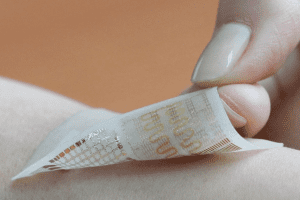
Researchers have created a new wearable device that is as thin as a temporary tattoo and can store and transmit medical data as well as release drugs into the skin.
The new device, details of which have been published in the journal Nature Nanotechnology this week, is the first that can store information and also deliver medicine, combining patient treatment and monitoring.
Its creators say that the technology could one day aid patients with movement disorders such as Parkinson’s disease or epilepsy.
The researchers constructed the device by layering a package of stretchable nanomaterials – sensors that detect temperature and motion, RAM for data storage, microheaters and drugs – onto a material that mimics the softness and flexibility of the skin.
The result was a sticky patch containing a device roughly 4cm long, 2cm wide and 0.3mm thick, says study co-author Nanshu Lu, a mechanical engineer at the University of Texas in Austin.
“The novelty is really in the integration of the memory device,” Stéphanie Lacour tells Nature, an engineer at the Swiss Federal Institute of Technology in Lausanne, who was not involved in the work. No other device can store data locally, she adds.
The trade-off for that memory milestone is that the device works only if it is connected to a power supply and data transmitter, both of which need to be made similarly compact and flexible before the prototype could be used routinely in patients.
This means that the device cannot as yet operate independently, and further innovation will be needed to help make it work.
Although some commercially available components – such as lithium batteries and radio-frequency identification tags can do this work – they are too rigid for the soft-as-skin brand of electronic device, Lu says.
Even if softer components were available, data transmitted wirelessly would need to be converted into a readable digital format, and the signal might need to be amplified.
“It’s a pretty complicated system to integrate onto a piece of tattoo material,” Lacour says. “It’s still pretty far away.”
Ben Adams
Related Content
Virtual Inspections: Embracing the Digital Change
Virtual inspections must become a part of companies’ repertoires if they aim to maintain quality …

COVID-19 is pushing healthcare firms to embrace digital transformation, reports suggest
The COVID-19 pandemic forced industries across the board to evolve or die with regard to …
British scientist develops technology able to deliver drugs directly into the brain
A British scientist has developed innovative technology that is able to deliver drugs deep into …